
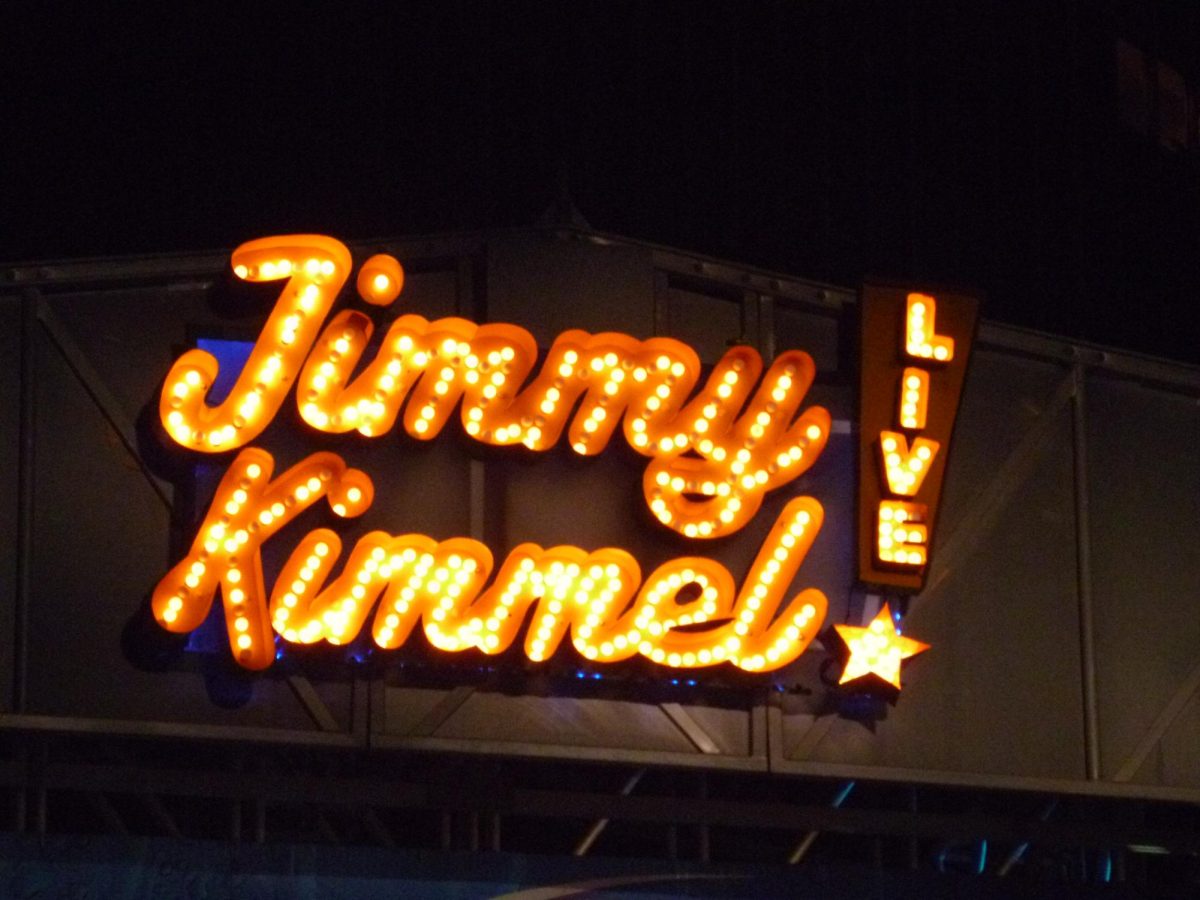
When Jimmy Kimmel made a satirical jab at Donald Trump’s response to Charlie Kirk’s death, it was business as usual for the late-night talk show host—until it wasn’t. Days later, Disney suspended the host’s show, ramping up the discussion surrounding free speech and increasing the fragility of late-night television.
“Jimmy Kimmel Live!” is ABC’s long-running, after-dark talk show, airing weeknights since 2003. Known for its celebrity interviews, comedy sketches and political commentary, the show has made Kimmel one of the most recognizable faces on late-night television. Over the years, Kimmel has built his reputation by mixing humor with the occasional cultural and political critique.
Recently, the show was briefly suspended by ABC’s parent company, Disney, over his comments on Kirk’s death during an episode of “Jimmy Kimmel Live!” on Sept. 15, 2025.
“We hit some new lows over the weekend, with the MAGA gang desperately trying to characterize this kid who murdered Charlie Kirk as anything other than one of them to score political points from it,” Kimmel said.
Later, he made more comedic remarks about President Donald Trump’s attitude towards Kirk’s passing.
“This is not how an adult grieves a friend,” he said. “This is how a 3-year-old mourns a goldfish.”
Federal Communications Commission Chairman Brendan Carr soon told ABC that the agency would take action due to Kimmel’s statements following a rise in media disruption from supporters of the Trump Administration.
“I said to my wife: ‘That’s it. It’s over,’” Kimmel recollected at a media conference to Bloomberg Screentime.
Students at Communications High School (CHS), such as junior Liam MacCarrick of Wall, see the situation as a breach of the First Amendment and a reflection of the current presidency.
“Really, any part of the government doesn’t have the right to tell a company what they should or should not say,” MacCarrick said. “Trump has definitely made an attempt to try and censor the people he doesn’t like, and I think this is the biggest example of that.”
Similarly, a CHS student, who wishes to remain anonymous, expresses concern for the future of television shows and restricted media in general.
“I feel like this is the start of [government censorship], and it’ll happen a lot more frequently in the future,” they said.
Other late-night television shows have also experienced sudden cancellations. Stephen Colbert recently announced that the Columbia Broadcasting System has scheduled “The Late Show With Stephen Colbert” to be taken off the air by May 2026.
It was announced as a final decision by Paramount, although there has been speculation that it is instead due to lawsuits issued by the Trump Administration.
CHS biology teacher Leah Morgan watches late-night show hosts Colbert and Kimmel and believes that Disney’s suspension of Kimmel was unwarranted.
“They definitely should not have done that, especially under political pressure to do so,” Morgan said. “I think that it’s showing government overreach and attempting to persuade what are supposed to be independent agencies.”
Additionally, CHS English teacher Joanne Colvin, who doesn’t frequently keep up with talk shows, agrees that Disney should not have interfered.
“I think it would be up to the public to decide if they want to watch Jimmy Kimmel, but for a company that’s influenced by political pressure to do something like that, I don’t think it’s right,” Colvin said.
On Sept. 22, 2025, Kimmel addressed his temporary suspension upon his return to ABC. He told viewers it was never his intention to make light of Kirk’s murder and voiced his concern by saying that Trump’s attempt to silence a comedian was very “anti-American.” Disney released a statement on the same day.
“We made the decision to suspend production on the show to avoid further inflaming a tense situation at an emotional moment for our country,” the Walt Disney Company commented in a public statement. “It is a decision we made because we felt some of the comments were ill-timed and thus insensitive.”
Although mass criticism resulted in Kimmel’s return to the program, the situation continues to raise questions about free speech, political influence, and the future of late-night television.
“They’ve received tons of backlash before but haven’t made many changes, but when this one political thing happens, it was completely removed from the air in a matter of one or two days,” said sophomore Lilli Koernig of Atlantic Highlands. “If this could be removed from the air so suddenly, what’s saying that it won’t keep happening?”