
From humble beginnings in the Wild West to a modern-day Midwest cult following, bronc riding is not for the faint of heart.
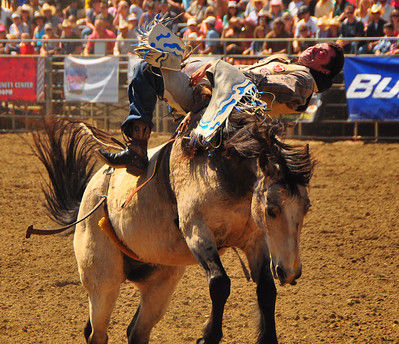
Bronc riding, an equine event with a vast history, stands beside the likes of bull riding as a staple of rodeo culture. Bronc riding originated in the mid-to-late 1800s during the peak of the American frontier. Ranchworkers in the West would “break” horses, or train young broncs to accept human handling and commands, for agricultural work.
Cowboys instructing their horses evolved into unorganized showcases to determine which rancher had the most horsemanship and natural talent. As bronc riding gained popularity, the first organized contest occurred on July 4, 1869, in Deer Trail, Colorado Territory.
By the 1900s, rodeos featuring bronc riding had become the largest event in the West, with paid admission and prizes becoming the norm. The sport continued its widespread acclaim, with a month-long rodeo in Madison Square Garden starting in the late 1920s.
There are two styles of bronc riding: saddle and bareback. In saddle bronc riding, riders hold onto a thick rein attached to the horse’s headgear as they are placed on a saddle. Bareback riding is the raw version of bronc riding, using no saddle as the riders hold onto a leather strap called a rigging.
In both styles, riders must be on their horse for at least eight seconds and hold on with only one hand for the run to count. The bronc and rider are rated out of 50 points and receive a combined score out of 100 points. The judges focus on the aggressiveness and unpredictability of the horse as well as the balance, agility, and control of the rider.
With the exciting and unrestrained moments that come from this sport, the opportunity for injuries or the mistreatment of the broncs is possible. Communications High School senior Colin Sales of Tinton Falls, who has experience with horses from Boy Scouts, believes that these horses should be treated properly, but recognizes that this is not a universal idea.
“The horses seem to be in good condition and seem to be treated well, but that doesn’t mean that it applies everywhere,” Sales explained.
The bronc riding and rodeo world constantly faces controversy about the nature of the sport. According to the Animal League Defense Fund, broncs used in riding are extremely likely to get internal organ damage, broken ribs, and broken tendons. The bronc riders getting concussions and knee sprains is also a common occurrence.
Bronc riding is definitely a sport that keeps audiences watching and conversations alive. The next time one of these competitions makes its way to television, be sure to consider the danger to the animals while enjoying the odd but exhilarating thrill of bronc riding.