
Communications High School’s newly installed fire alarm system got an unexpected real-world test Thursday afternoon when a chemistry lab triggered an emergency evacuation, sending confused students and teachers pouring into the hallway.
The fire alarm sounded shortly before 1:45 p.m after a chemistry lab involving boiling salt water activated a nearby smoke detector in chemistry teacher Erin Wheeler’s classroom, Principal Emily Bonilla said. Wheeler said she has done the lab for several years, and it has never triggered a reaction from the fire alarm system. According to Bonilla, the new alarm system is more sensitive, which likely contributed to the detector reacting to steam from the chemistry lab.
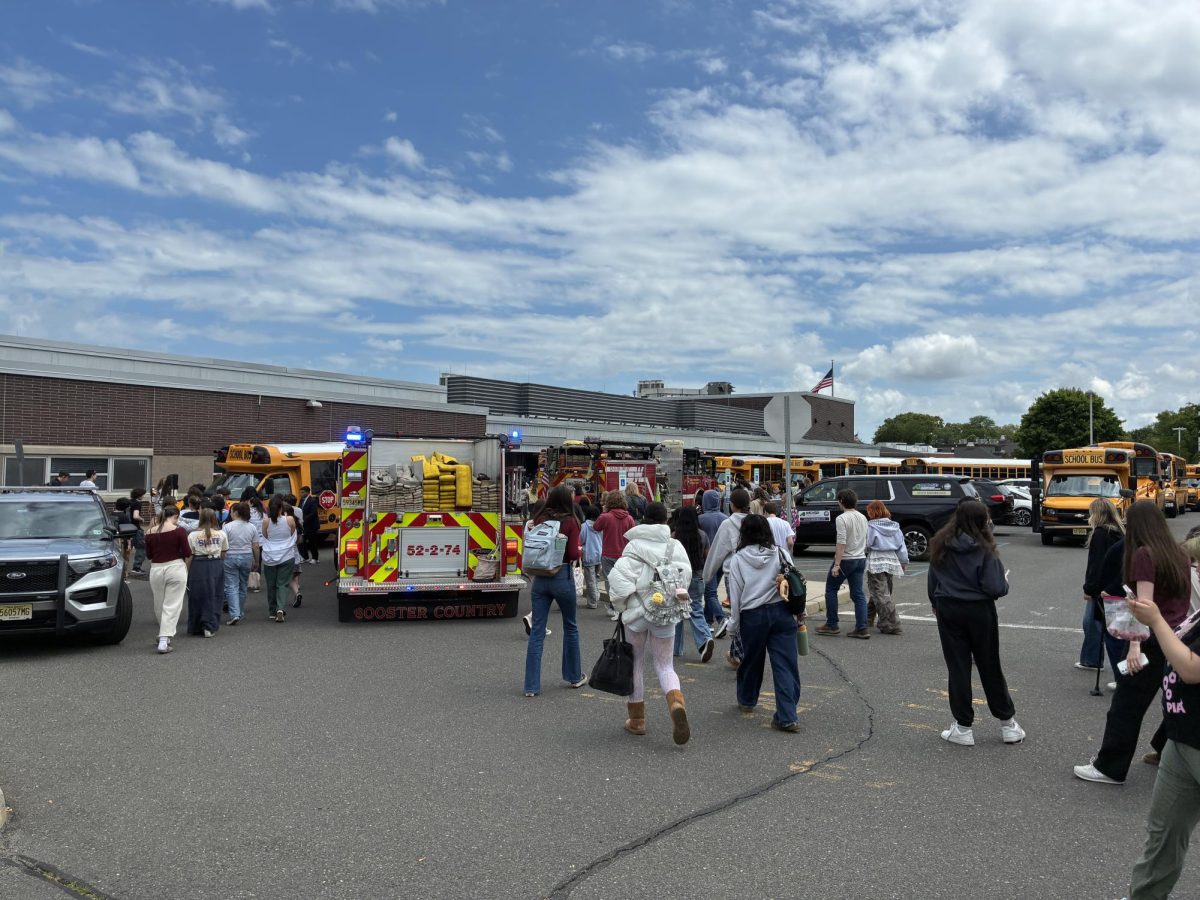
Fire trucks and police arrived on campus around 1:50 p.m. Students remained outside for several minutes while emergency responders checked the building. They were allowed back inside shortly before 2 p.m. Bonilla said the school could not resume classes until first responders officially cleared the building.
Students and teachers initially appeared unsure whether the alarm was real, as no drill had been announced beforehand. Senior Dylan Glusman of Middletown was in English teacher Jaime Vander Velde’s class at the time and said her teacher’s own confusion is what tipped her off that it was not a routine drill.
“[Vander Velde] always knows when there’s a drill, and she did not know what was happening, and so that’s when I knew that something was wrong,” Glusman said.
Junior Charlotte Mathias of Long Branch, who was in Wheeler’s classroom at the time, said students first assumed the alarm was part of a planned evacuation.
“Everyone was just focused on their own work and on their own lab and when we heard the fire alarm go off, we didn’t even think it was real,” Mathias said. “We thought it might be a drill, but then we saw the smoke in the back of the class.”
Students began filing out of the building with teachers wrangling groups of students trying to keep everyone settled despite the excitement and confusion. Glusman described a hallway full of students unsure where to go, despite practicing in numerous drills throughout the year.
“It was complete chaos in the hallway. Nobody really knew what door to go out of, and so everyone was just going in their own direction, until teachers started telling us where to go,” Glusman said. “Then once we got outside, we just went to our normal fire drill positions so that helped the chaos calm down.”
Vander Velde echoed Glusman’s assessment of the situation, noting that while students had a general sense of evacuation routes, there is still room for improvement.
“I think people roughly knew where to go. It’s always good to know where to go out in the parking lot,” Vander Velde said. “I would encourage everyone to probably walk faster if they think that it’s a real fire.”
Math teacher Justine Lane, who has worked at the school for nearly 20 years, said Thursday’s incident marked the first fire evacuation that was not a drill that she can recall.
“There’s never been an actual fire alarm that wasn’t just a practice,” Lane said. “This was the real thing.”
Bonilla acknowledged the incident served as a learning experience for staff and highlighted areas where emergency procedures could be improved.
“There were mistakes made, and they were corrected,” Bonilla said. “We’re not used to so many emergency situations, so there were steps that were not done correctly.”
She added that she is already reviewing evacuation procedures and communication protocols.
“I’m gonna use this in my next talking point with the staff,” Bonilla said. “We will also be addressing what the correct student behaviors are in a drill.”
Despite the disruption, Glusman said the incident reinforced the value of the school’s upgraded safety measures.
“Especially at such a small school, having updated safety measures like this is important, so I’m really relieved that it worked and was taken seriously,” Glusman said.