

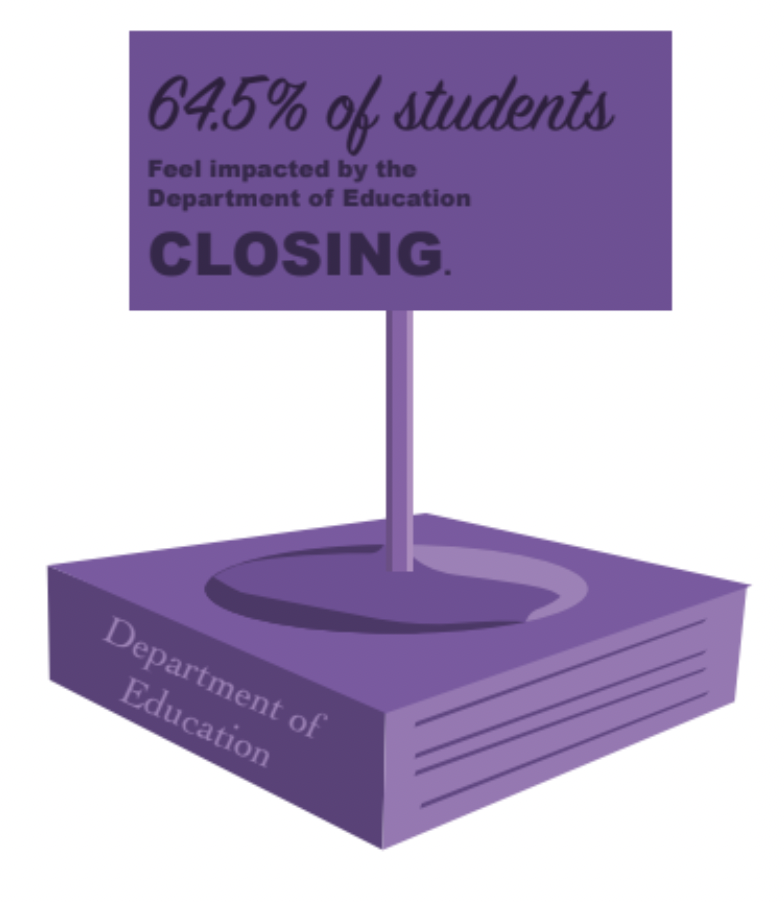
Students, parents and teachers are raising concerns after President Donald Trump signed an executive order on March 20 which began the dismantling of the Department of Education (ED).
According to the ED’s official website, the original goals of the department were to increase coordination between federal and state education programs, provide federal funding to schools and research institutions, ensure equal access to educational opportunities, and improve the quality of education nationwide, among other aims. Up until now, the department has continued to fund schools and institutions as well as protect students against discrimination.
Support for federal involvement in education traces back to the 1860s, when President Andrew Johnson signed legislation that created the original ED. Due to worries that the new department would have too much control over local schools, the ED was promptly downsized to the Office of Education, which dealt mostly with statistics regarding education.
However, in the mid-20th century, support for the department once again grew. In 1979, Congress passed legislation that recreated the Department of Education as a cabinet-level department.
Since its inception, the ED has been subject to much controversy. Until now, the most potent threat to the institution came from President Ronald Reagan, who made the abolition of the newly created institution part of his campaign. However, Reagan failed to obtain congressional support to dismantle the department, and calls for its elimination fizzled out.
Since then, efforts to decentralize education have been a staple of conservative policy.
Trump’s presidential campaign renewed calls to abolish the ED. According to the Associated Press, Trump has claimed the department is wasteful and is filled with “radical zealots and Marxists.”
Throughout his re-election campaign, Trump vowed to eliminate the department and grant the states control over education. In addition, he called for the reallocation of some of the ED’s services to other departments. For example, according to the British Broadcasting Corporation (BBC), the duty of enforcing civil rights protections was moved from the ED to the Justice Department. In his executive order, he also cited failing student performance and the ED’s management of student loan debt as other reasons for closing the department.
Other conservatives have expressed this viewpoint on federal involvement in education. Notably, Project 2025, the conservative policy blueprint written by conservative think tank The Heritage Foundation, included a section that called for the elimination of the department and funding provided by it.
While President Trump has instructed Education Secretary Linda McMahon to begin dismantling the department, he cannot close it outright. This is because the ED was created by Congress and cannot be closed without congressional approval.
Eliminating the department would most likely require a supermajority in the Senate, which, according to the BBC, is unlikely. However, the Trump administration has already laid off half of the department’s employees, severely damaging its ability to function.
Opponents of President Trump’s move argue that the department’s closure could have severe consequences on education nationwide. Many say that funding for schools in low-income communities could be impacted because schools in these areas depend on federal funding, which would stop with the closure of the department. Additionally, some argue that the ED functions like special education and protections against student discrimination, which are being transferred to other departments, could suffer from neglect.
Another major aspect of education — Science, Technology, Engineering, and Mathematics (STEM) — would also be affected by the department’s closure. The ED provides funding, resources, and research to STEM programs nationwide. The abolition of the department could jeopardize those funds, the result being the loss of resources and information for STEM curricula around the country.
The CHS community finds its own concerns in the coming changes. When asked about potential impacts on the scientific community in the future, CHS biology teacher Leah Morgan cited concerns that abolishing the department means sacrificing the U.S.’s future in scientific advancement.
“Without the Federal Department of Education, the grants that go to colleges and universities that fund research could be greatly diminished, allowing the United States to fall behind in the scientific race for discoveries of very important scientific and medical advancements.”
On the other hand, Erin Wheeler, CHS Chemistry teacher, doesn’t think this legislation will impact the scientific community.
“I know that the Department of Education is focused on special education, so I guess students with special needs will be drastically impacted more so than specific subject areas per se.”
All of these changes leave CHS Senior Avery Booth concerned for her future. Booth’s future is left uncertain as she prepares to enter the medical field, attending Fairleigh Dickinson University as a nursing major this coming fall.
“I’m pretty worried, I think that just in general, the stem field is being pushed down more and more, especially with many healthcare workers being fired, it’s pushing back our opportunity for progress as a nation and as just in general not allowing people to reach their full potential will damage us in a way that I can’t even imagine.”
Though there is no knowing what the future may hold, and the existing predictions are riddled with disagreements, it is undeniable that this legislation will bring much change to the U.S. for better or worse.