
With school back in session, many returning students are struggling to adapt to Communication High School’s (CHS) new schedule introduced for the 2025-2026 school year.
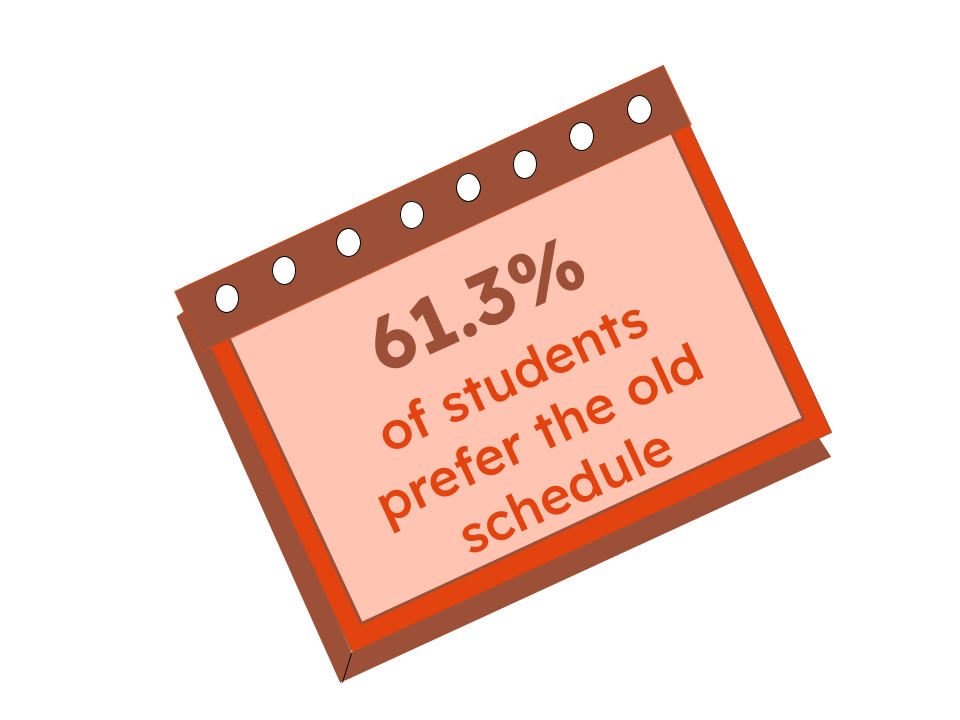
In the past, the day was split into four approximately 90-minute periods a day and was broken up evenly between two semesters, punctuated by midterms and finals.
With the new schedule, students now have all of their classes year-round, with five 67-minute periods a day. Some benefits include the addition of Advanced Placement classes, double Career and Technical Education elective blocks, and full days of mentorship for seniors. However, with so many drastic changes, many are wondering if the sudden shift is really for the best.
One of the main complaints from the student body is the number of assessments that come with taking all eight classes at once.
“I’ve been incredibly stressed out because I’ve had seven tests in the past two weeks,” sophomore Mina Lee of Middletown said.
Junior Savannah Williams of Marlboro shares Lee’s stress, finding herself struggling to keep up with the heavy workload that has come with the schedule switch.
“It seems like every night I’m going home with crazy amounts of homework,” Williams said. “How is this schedule meant to make our lives better when it’s clearly not?”
Aside from increased stress from assignments, the new schedule is also making it harder for students to retain what they have learned. According to a memory retention study from indegene.com, “Within 24 hours, [the average person] forget[s] an average of 70% of new information.”
Junior Liam MacCarrick of Wall agrees, asserting that he feels the new schedule has created a lack of material retention among students.
“The schedule makes it hard for anything to stick. Every day feels like I haven’t been to class in a while,” MacCarrick said.
Many have also found the schedule to have negative social impacts, with the change causing most students to have the same group of people in all their academic courses.
“I find it so limiting because I’m stuck with the same people,” Williams said. “There’s no one new to talk to; it kind of limits you if you want to make new friends.”
But students aren’t the only ones feeling uneasy with this sudden change.
The faculty also had to adjust to shorter amounts of time to teach their respective subjects for entire grades at once. CHS science teacher Leah Morgan shared her own struggles amidst juggling her forensics, freshmen biology and advanced biology classes.
“I’m still getting used to planning four different classes all with different due dates and schedules, [and] labs are much harder to prepare,” Morgan said.
As teachers try to keep classes at a similar pace, it becomes increasingly more difficult to schedule deadlines in conjunction with other classes, leading to avalanches of assignments all at once.
Not only are lessons becoming harder to plan, but with the dissolution of midterms, 20% of a student’s grades in a class now rest solely on the final exam.
“Now more than ever, end-of-unit projects and tests are more important because it’s the only way I can assess,” CHS English teacher Emily Soto shared.
Despite the schedule change being made with good intentions, its impact has been anything but positive. While teachers struggle to teach their curriculum to entire grades at a time, students are drowning in coursework and assessments.
“It seems that everything is more stressful and more work,” MacCarrick said. “I’m very disappointed in the changes.”